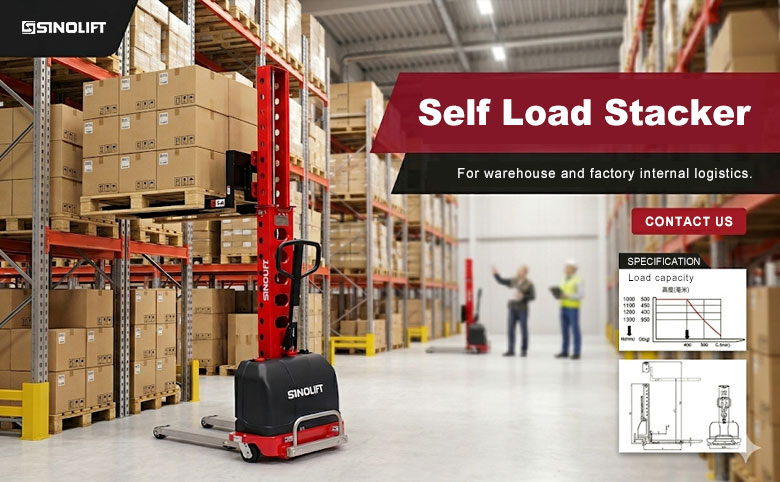
What's the real difference between manual and electric pallet stacker?
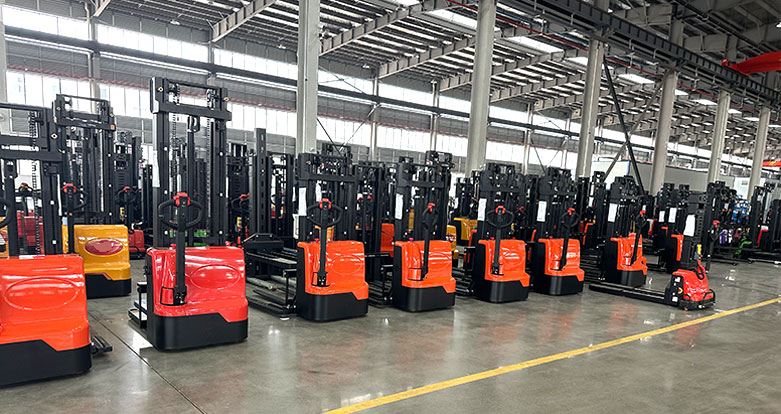
Manual pallet stackers and electric pallet stackers fulfill complementary roles in contemporary material‐handling operations. Manual straddle stackers deliver unadulterated hydraulic simplicity—ideal for compact layouts and intermittent use—where premium steel masts and adjustable forks provide reliability without electronic complexity. By contrast, full electric stackers such as the CDD20N integrate high-efficiency AC drives and C-shaped gantry steel for seamless lift-and-drive performance in continuous, high-throughput environments . Choosing between them hinges on load requirements, lift height, total cost of ownership, ergonomic considerations, and charging infrastructure.
Manual Pallet Stacker: Simplicity and Versatility
Design and Operation
A manual pallet stacker, also termed a hydraulic straddle stacker, employs a hand-operated pump to pressurize oil into a cylinder, raising the forks in calibrated increments. Straddle legs flank the forks, imparting stability even when handling off-center loads, while forged, adjustable tines accommodate diverse pallet widths . The stripped-down mechanism ensures minimal points of failure and reduced maintenance complexity.
Capacity and Lift Height
Typical capacity ranges span from 1,000 kg to 1,500 kg, with heavy-duty configurations extending to 2,000 kg. Forks retract to a mere 85 mm clearance for loading under low-profile pallets and elevate to heights of up to 1,600 mm—transforming the stacker into an agile mini lift for shelving tasks . Special-purpose models push lift heights beyond 2,000 mm while preserving load stability via reinforced duplex masts.
Maintenance and Durability
Without batteries or electric drive components, manual stackers sidestep many common service needs. A periodic lubricant top-off and seal inspection suffice for most maintenance schedules. The all-steel chassis and mast assembly deliver decades of punctilious service, even in corrosive atmospheres when galvanized or stainless-steel variants are specified .
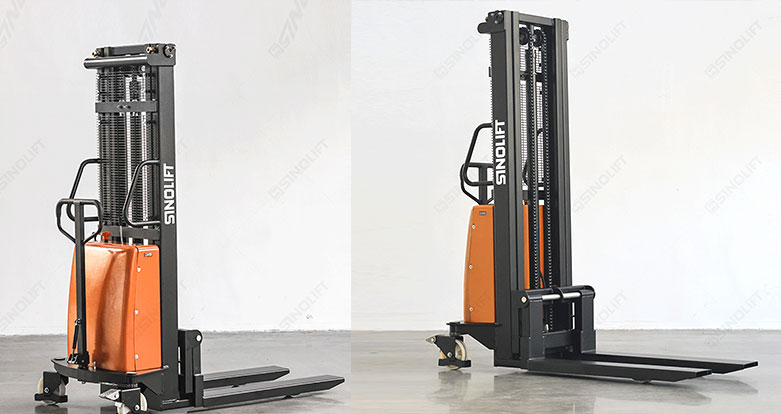
Semi-electric pallet stacker with width leg and narrow leg
Electric Pallet Stacker: Power and Efficiency
Drive and Control Systems
Electric pallet stackers fuse a high-torsion AC drive motor with a powered hydraulic pump, enabling operators to both transport and lift pallets through fingertip controls . Electronic steering ensures razor-sharp turning radii in congested aisles, while programmable braking systems safeguard against unintended drift.
Battery Technology and Charging
Battery choices include gel (AGM), lead-acid, and advanced lithium-ion chemistries. Gel and lead-acid systems typically demand at least 6.5 hours for a full recharge but offer cost advantages upfront. Lithium-ion batteries, however, afford opportunity charging and recharge in as little as 1.5 to 3 hours while enduring up to 3,000 cycles—dramatically reducing lifecycle expense.
Throughput and Ergonomics
An electric stacker such as the Sinolift CDD20N maintains consistent travel speeds up to 4 km/h under load and lifts 2,000 kg to 3,000 mm in fractions of a minute . Operator fatigue plummets as the need for manual exertion is eliminated, translating into sustained performance through multi-shift operations and a marked reduction in musculoskeletal complaints.
Frequently Asked Questions
1. What is a manual pallet stacker?
A manual pallet stacker, also known as a straddle or walk-behind stacker, is a hand-pumped hydraulic device designed to lift and position pallets on shelving or racks without electric assistance .
2. How does a manual pallet stacker operate?
Operators actuate a lever or foot pedal to force hydraulic fluid into a lift cylinder; forks ascend in graded increments until the release valve is toggled to lower loads safely.
3. What load capacities do manual stackers support?
Standard manual stackers handle 1,000 kg to 1,500 kg; heavy-duty CTY-W models elevate this to 1,500 kg with adjustable leg widths spanning 550 mm to 1,250 mm .
4. What defines an electric pallet stacker?
An electric pallet stacker couples a rechargeable battery with an AC drive motor and electric hydraulic pump, enabling one-step lift-and-move cycles via ergonomic control tillers.
5. How long does it take to charge an electric pallet stacker?
Gel and lead-acid variants require a minimum of 6.5 hours for complete recharging, while lithium-ion systems can recharge fully in 1.5 to 3 hours and permit opportunity charging to eliminate downtime.
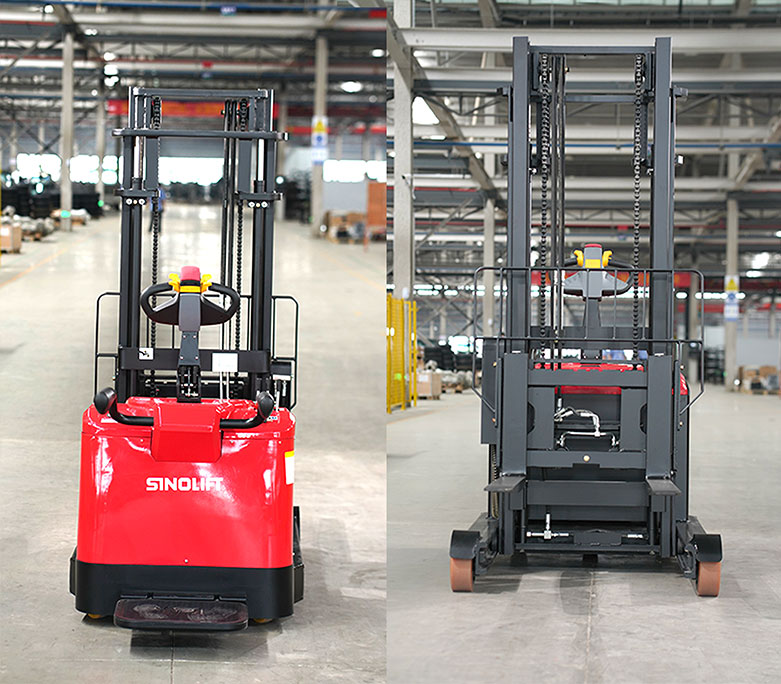
Product Showcase
Sinolift CDD20N Full Electric Pallet Stacker
- Capacity: 2,000 kg
- Max Lift Height: 3,000 mm
- Drive System: Maintenance-free AC motor with electromagnetic brakes
- Battery: Lithium-ion option for rapid recharge and opportunity charging
- Outstanding throughput in high-volume, multi-shift warehousing.
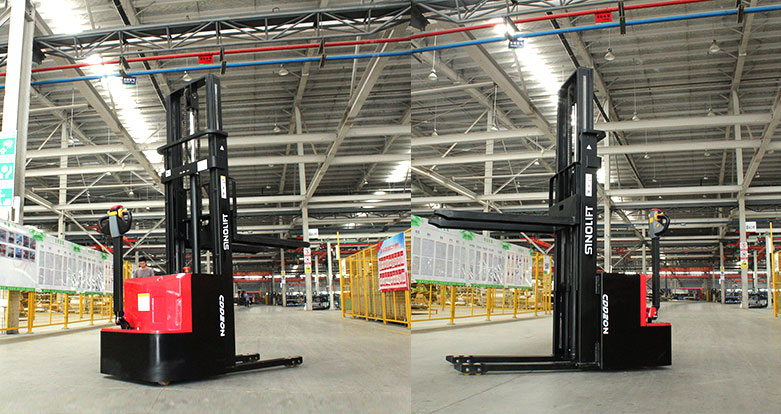
Manual pallet stackers and electric pallet stackers each possess distinct value propositions. The manual pallet stackers thrives in budget-sensitive and spatially constrained settings, delivering unimpeachable simplicity and durability without electronic servicing overhead. Conversely, the CDD20N electric stacker epitomizes ergonomic innovation and throughput maximization, making it indispensable in demanding, high-frequency operations. By aligning stacker specifications with your facility’s throughput requirements, lifting heights, and budgetary constraints, you can harness the full potential of Sinolift’s engineered solutions. Armed with this comprehensive analysis, you are poised to select the stacker that will elevate both your pallets and your profitability.
Sinolift offers customized services to meet various customer requirements. If you are interested in our products, feel free to contact us for more information. Visit our website at //www.sinoliftcorp.com, or reach us
via email at market@sinolift.com or WhatsApp: +8613817178390.
Self Loading Stacker: How to Choose the Right Model for Warehouse and Delivery Efficiency