How to Choose a Mobile Floor Crane: Comparing Sinolift's Counterbalanced and Telescopic Boom Models
How to Choose a Mobile Floor Crane: Comparing Sinolift’s Counterbalanced and Telescopic Boom Models
A practical guide to choosing between full-electric, semi-electric, manual, engine-hoist, telescopic-boom, and the latest mobile floor crane configuration.

A quick view of the current product family
When a workshop needs to lift an engine, position a machine component, or move a load through a production area, the challenge is rarely lifting alone. The equipment must also approach the load, maintain stability, fit the available aisle, and give the operator enough control at the final position. A mobile floor crane can combine these requirements in one compact handling solution.
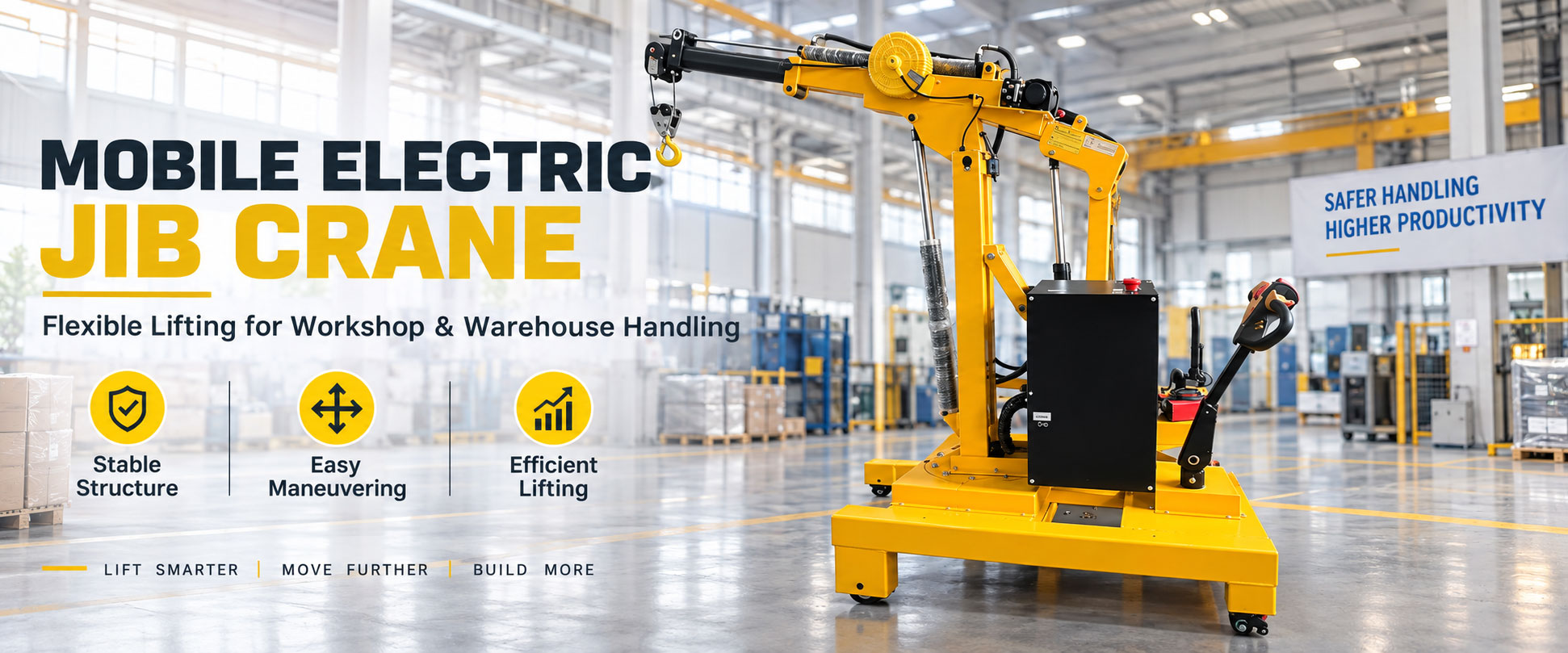
Sinolift’s current directory includes full-electric, semi-electric, manual, engine-hoist, and telescopic-boom configurations. The latest product supplied for this article replaces the previous YLE01 and YLD01 references. Its model number and final data sheet have not yet been released, so it is presented as the latest model rather than assigned an unconfirmed specification.
| Product | Configuration shown | Best starting point for |
|---|---|---|
| FSCB550 | Full-electric counterbalanced crane jib | Powered lifting and counterbalanced handling |
| SSCB550 | Semi-electric counterbalanced crane | Powered lifting with a simpler operating concept |
| SCB550 / SCB750 | Manual counterbalanced crane jib | Robust manual workshop handling |
| YLH01 | Full-electric floor crane / engine hoist | Engine, machinery, and component handling |
| YLF01 | Cantilever telescopic boom mobile floor crane | Adjustable reach and controlled positioning |
| Latest model | New mobile floor crane shown in the supplied factory photo | Replacement evaluation for YLE01 and YLD01 |
1. Match the power configuration to the workflow
The FSCB550 and YLH01 are identified as full-electric products. They are natural candidates for operations where powered lifting and repeatable movement are important. A full-electric configuration can reduce manual effort during regular handling cycles, but buyers should confirm battery voltage, charging method, drive speed, lifting speed, and duty cycle before ordering.
The SSCB550 is identified as semi-electric. This can be a practical middle ground when the lifting function benefits from power but the application does not require the same operating concept as a fully electric mobile crane. Selection should be based on the number of moves per shift, floor conditions, and the distance between pickup and placement points.
2. Choose the boom style by reach, not appearance
The SCB550 and SCB750 provide a manual counterbalanced route. Their product information highlights a heavy-duty design, a five-position telescopic jib, a double-acting hydraulic pump with a pressure relief valve, a heavy-duty swivel hook with safety catch, removable weights, and a powder-coated finish. Buyers should confirm the capacity chart at every jib position rather than treating the model name as a complete load rating.
The YLF01 is the clearest example of why boom reach matters. Its published table lists boom lengths from 1620 to 3270 mm, with corresponding load capacities from 1000 kg at the shortest listed reach to 300 kg at the longest listed reach. Extending the boom increases the working envelope, but the allowable load changes with the reach position.
The YLF01 page also lists ±60° boom rotation, a 2150 mm turning radius, an 852 mm straddle-leg width, electric drive, a 24/210 battery, a 1.2 kW drive motor, a 2.2 kW lift motor, and a 1070 kg net weight. These figures are useful for initial planning, but the final configuration, floor loading, doorway dimensions, and turning space should be checked for the intended site.
3. How the latest model changes the selection conversation
The photo shows a yellow mobile crane with a cantilever boom, hook assembly, counterbalanced base, and operator control position in a workshop environment. It should be treated as the current visual reference for the new product family entry.
Before quotation, request the confirmed model number, rated capacity, boom reach positions, lifting height, power source, battery or charger details, overall dimensions, turning radius, and safety documentation. This keeps the website content accurate while allowing Sinolift to update the product page when the final specification is approved.
Product family reference images


A practical buyer checklist
- Maximum load and load center, including any uneven or suspended load condition.
- Required boom reach from the crane’s centerline to the pickup and placement points.
- Lifting height, overhead clearance, doorway width, aisle width, and turning radius.
- Number of lifting cycles per shift and the distance the crane must travel.
- Preferred power configuration: manual, semi-electric, or full-electric.
- Floor condition, ramps, thresholds, and trailer or dock access.
- Required hook, sling, spreader, or other attachment arrangement.
The directory gives a useful first comparison, but these application details determine the final safe configuration. A product that looks compact in a catalog may require additional clearance once the boom is extended and the load is attached.
Conclusion
Sinolift’s current range covers several different handling priorities: full-electric lifting through FSCB550 and YLH01, semi-electric operation through SSCB550, manual hydraulic counterbalanced handling through SCB550/SCB750, adjustable reach through YLF01, and the latest replacement model shown in the new factory photo. Start with the load-and-reach requirement, then confirm power, dimensions, stability, and safety documentation with the manufacturer.
Ready to specify the right mobile floor crane?
Send the maximum load, required reach, lifting height, aisle conditions, and preferred power configuration for an application review.
Contact SinoliftEmail: market@sinolift.comWhatsApp: +86 138 1717 8390Source: Sinolift mobile floor crane product directory and YLF01 product page. Latest model image supplied by Sinolift.
How to Choose Between Manual, Semi-Electric and Full-Electric Paper Roll Lifters